
TRANSCRIPT
Gissele: [00:00:00] Hello and welcome to the Love and Compassion Podcast with Gissele. We believe that love and compassion have the power to heal our lives and our world. Don’t forget to like and subscribe for more amazing content. And if you’d like to support this podcast, don’t forget to buy us a coffee at, buymeacoffee.com/loveandcompassion
Gissele: Today we’re talking about relationships and my guests today are
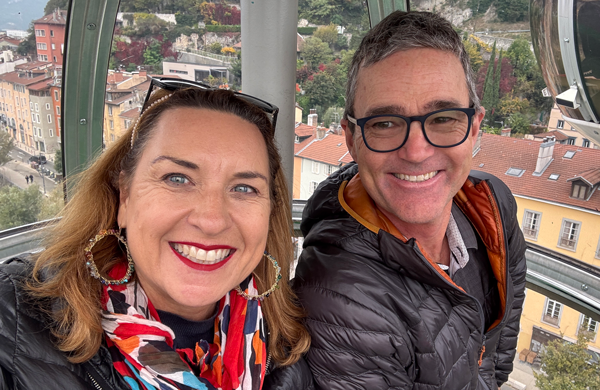
Gissele: Zeke and Terry Mead, who are empty nesters, midlife adventure travelers from the San Francisco Bay Area in 2021. After 25 years of marriage and nearly getting divorced, they accidentally rebooted their relationship and embarked on a new set of adventures.
Gissele: Embracing their differences in challenging themselves to grow individually and as a couple on a daily basis. They couldn’t be more different, but they have a long history, a solid foundation, and a steadfast commitment to making it work as they travel and explore the world mostly together. Please join me in [00:01:00] welcoming Zeke and Terry Mead.
Gissele: Hi.
Terry: Hi.
Gissele: Hello. Welcome to the show. I was wondering if you wanted to tell the listeners a little bit about how you actually met.
Zeke: Terry is the one who usually does it so . Go ahead.
Terry: Yeah, usually I do. we’ve known each other for 45 years. We, yeah, we both grew up in the San Francisco Bay area and when we were in elementary school, there was the gifted and talented education program gate.
Terry: And all of the kids who are part of gate converged at the same school once a month, twice a month for enrichment activities. And I have an identical twin sister. And one month we showed up at a school. Zeke remembers meeting us. I don’t really remember meeting him. But a couple years later, we all went to the same junior high school.
Terry: And so we were in the same classes. And in the eighth grade we went together. For about six weeks. I dumped him. That makes for a better [00:02:00] story if I say that. And then we were friends through high school and if you want the full origin story, we went to different colleges. We dated when we were 21.
Terry: I dumped him again. We dated again when we were 24. I dumped him again and then we were 25. I made a list of everything that I wanted in a man for the rest of my life. And Zeke met all the criteria, except he was essentially the boy next door that I dumped three times. So then we were skiing when we were about 25 and had a little bit too much wine that night.
Terry: And I just said this needs to be the last time and either we’re going to get married or friendship has to be over ’cause we just can’t keep doing this. And 14 months later, we were married.
Gissele: what kept you holding on there? Zeke?
Terry: Insanity.
Zeke: Yeah. When you are 10, 12, 13 years old and you start to develop these relationships with people, you are [00:03:00] your conscious, gloms onto just interesting, specific, different characteristics.
Zeke: And Terry was always someone that was just this person that I was always drawn to. And so whenever our planets would circle back around and come in alignment, it would all be like, okay, so I’m attracted to this person, and let’s see what this is all about this time.
Zeke: And then the counter to that, the joke is Terry’s ability to evaluate things at 25 obviously wasn’t very good.
Terry: I was playing the long game. Really? I was playing
Gissele: the long game. so fast forward you, do you have children?
Terry: We do. Our son is 24. He is doing a master’s degree at San Francisco State.
Terry: He’s back living with us and our youngest is they them and they’re 21 wrapping up their college, their undergrad at University of Vermont in Burlington.
Gissele: Beautiful. Beautiful. Okay. So you are married, are having relationships. Fast forward to the, when you start to have problems again. [00:04:00]
Terry: I think,
Terry: We’ve done a lot of work on ourselves and especially in the last four years, I guess it’s 20, 26, 5 years when we thought we were gonna get divorced. We came into the marriage at 26. We look at back at it just so young and so naive and with really the wrong expectations and assumptions about what a relationship is and what a marriage is.
Terry: And Zeke was in a software sales or banking when we got married and later decided to become a police officer. And that ended up putting a significant amount of pressure on our relationship with the shift work. four days on, four days off, five days on, three days off, back to back fives called in for overtime, called in for court times.
Terry: And, after the kids were born, I was essentially a single parent working full time. And I launched a consulting company, and so then I was managing a company as well, and that really, we did not know how to navigate that. what we later learned is I have [00:05:00] an anxious attachment style and he has an avoidant attachment style, so naturally going in different directions.
Terry: He’s an only child. I’m an identical twin, so I used to doing everything together. I shared a womb with someone and
Zeke: I didn’t share a room with anyone.
Terry: exactly. So what we had was a solid foundation in that we grew up in the same place, knew a lot of the same people. But we did not know how to do the work. And so our relationship I think in our early forties was when it really started to, it really started to get, I wanna say bad logistically we’re really great with each other.
Terry: But I think emotionally lovewise there was a lot of resentment there and there was like a huge chasm. And over the course of about 10 years, we would each show up. One of us would show up and say, okay, I think we’re done. And the other one would say, I’m not ready. And so we battled that for. seven to 10 years.
Terry: Early in, like when I was about 43, I started [00:06:00] perimenopause and I didn’t really know it. So of course that also introduced a new set of challenges that I neither of us knew was really going on. Andour forties, it was it was very difficult, but then the pandemic hit when we were 50, and of course we came together in order to support the kids in order to be better citizens of the world.
Terry: And logistically, I think we did really well. But, in January of 2021 both of us, it was like the first time we’d had like a text fight and I was in the bathtub and he came in and one of us was like, I think we’re done. And the other one was like, yeah, I think we’re done. it was a long time coming.
Gissele: Yeah. Thank you for sharing that. It must have been really challenging. I just wanna go back just for a moment. When you talked about the avoidance style in the anxious style, can you tell the audience a little bit about what that looks like? Because some of them might not know they are an anxious style or avoidance style.
Gissele: So what does an anxious style look like, and what does an [00:07:00] avoidance style look like?
Terry: So for me, the anxious is I’m constantly looking for validation. am I loved, am I worthy? yeah. Does he love me? Does he not? And so when there’s any sort of friction or conflict, I’m like wanting closeness and validation.
Terry: And for him, when there’s conflict and whatnot, then he pulls away. So then there’s this whole chasing kind of thing. So I want more. He runs away. That makes me feel more insecure. I go chasing after it. That makes him insecure and he wants to go into his cave. it’s this chasing kind of thing.
Terry: And
Zeke: it doesn’t work out well,
Terry: not when you don’t have an awareness of it. I I’m trying to get better about it. He’s getting better about it. And I think also growing up so there were three of us kids in the family and there was a lot of dialogue and there was a lot of fighting.
Terry: And I wouldn’t say it was good communication, I learned how to fight, not necessarily dirty, but I learned how to fight. Whereas he didn’t [00:08:00] practice that with with siblings. And so then also with that also complicates it in that he would need extra time to think about whatever was going on.
Terry: And I’m like, engage, engage, engaged. And he’s like, whoa, I need some space. And I’m like, engage, engage, engaged. And that would just make me more anxious to not have the engagement. It would make him more uncomfortable when I’m coming at him. And so you, you have that complicating the anxious avoidance clash as it were.
Gissele: Yeah. if you’re anxious which I used to be. Whenever you have the withdrawal the avoidance, it’s interpreted as there’s a withdrawal of love. I’m not lovable. Mm-hmm. I’m not worthy. but really it has nothing to do with that.
Gissele: It has to do how the other person’s ability to cope and need to regroup. Right. And so for me having to shift that I had to really be aware of how little I was there for myself and how little I love for myself that I could, [00:09:00] I had to realize that I could tap in instead of going outward. I could tap inward and be able to give that to myself.
Gissele: And sometimes it’s so funny, is a weird dance because I’ve seen situations where I would have the opposite effect. I would be more avoidant if the person was different. if their energy was more anxious, I would be more avoidant and then they would gravitate.
Terry: Yeah, it’s an interesting dance and one of the things that I’ve tried to be better about is to express my insecurity to Zeke and just say, look, right now I need a little bit more, I need some validation right now. ’cause I’m, I also have ADHD. So then you’ve also got that tied into it.
Terry: And so if I communicate to him, look, I need a little bit more. I need some I need to know that I’m loved right now, I’m feeling in a sensitive and vulnerable space. And then having that specific request, then, if he’s able to at that moment and we’re not talking like in a fight, we’re just talking in life in general, then he’s able to step in I think a little bit more easily to respond [00:10:00] to that request.
Terry: And then I’ve asked him, it’s okay. If you’re gonna go avoid me, can you just say, look, I just need some time. I wanna deal with this. I need some time. And that’s also super hard for him to do because in those moments when he pulls away, he shuts down. And so to have the wherewithal to go, look, I need a minute.
Terry: I’ll come back, I will come back.
Gissele: it’s the understanding that it’s not about you like that, it’s not about either of you. It’s that it’s about the person’s ability to cope in that moment and how they cope or how they’ve learned to cope based on their own childhood environments.
Gissele: And so really when you have an understanding of each other’s childhoods and when you have an understanding of what each of the you need in the moment I think it’s really helpful for relationships. Yeah.
Terry: We’re still practicing that by the way. We do not have
Gissele: that dial.
Gissele: Yeah, of course. And you know what? Relationships are an ongoing, there’s peaks and valleys, there’s highs and lows, and I love that you said that, at one moment you both had to be [00:11:00] wanting out. ’cause as long as one of you wanted to stay in, that’s usually how people stay in a relationship.
Gissele: Right. But when you get to the point where you both want out, I think that’s where you, start to decide we have to really look at this and either decide to go in and out. So what happened after you both decided that it was like, that it wasn’t working and that you needed to maybe move forward differently?
Terry: So it happened on a Sunday morning and the both of the kids were home. Our youngest was still in high school and our oldest was home for winter break. And we both decided, okay, we’re gonna communicate to the kids that this is what’s going on. So at dinner that night, we told the kids, and the kids were like, it’s about time.
Terry: kids totally know when there’s friction. They know and they’re just like, yeah, it’s about time. And we did not model, I think healthy partner relationship for our kids. We’re still trying to fix that. We still apologize for that too. Our kids. And the timeline on this is going to seem really fast, but I process things really fast [00:12:00] and I’m a silver lining kind of gal and I can usually get over things within 24, 48 hours because it was the middle of the pandemic we’re in the San Francisco Bay area.
Terry: We were still in lockdown. And, our son was going back to school, we had an extra bedroom. So Zeke moved into our son’s bedroom. But, oh, we decided we were gonna work through this together. we are friends first. We have known each other for so long, and we’re also very committed to our kids and providing a solid foundation for our kids.
Terry: So he moved into the bedroom, and so the next day, he was in the bedroom doing his work. I was in the office doing my work and and our youngest was doing remote school. And I would come out and I would just start sobbing. and we would be talking through what is this gonna look like?
Terry: He did look at apartments. But we also decided every night we would cook together, we would have dinner together. And while we hadn’t really watched TV together before each night, we were trying to do that to demonstrate to our youngest that we were still a united front for them. [00:13:00] And so Monday rolls around.
Terry: I was devastated. I really thought my whole world had fallen apart because what I thought my future was going to be had collapsed. I thought we were going to be partners forever, the kids were getting older and it was supposed to be just us again. And so Tuesday rolls around and I am still devastated.
Terry: Wednesday rolls around, I am still devastated. And I remember asking Zeke, I’m like, how can you not be devastated by this? And he said, you always move through things much more quickly than I do. This is gonna hit me later. We researched over the course of that week, we researched buying a house in the same street so we could still be near each other, still support each other.
Terry: We we talked about what it was gonna look like and Thursday, Friday rolls around and I just looked at him. I’m like, I periodically I’d go in, I’d sob, he told me. And I would just say it was like, who’s gonna be my emergency contact? And he said, I will always be your emergency contact.
Terry: And it was at that moment that I think [00:14:00] that was the, I know that seems silly, but that was like the last thing that I needed to go. It’s gonna be okay. So I did some research on dating and how to move forward, past divorce, we were never actually gonna get fully divorced because our financial situation is so complicated.
Terry: So we would leave very separate lives, but the legal part of it would, we weren’t gonna make happen, and neither of us ever wanted to get married again. So it was like, okay, we’re not gonna deal with the legal side of it, but what logistically does this look like? And then Saturday morning I went to go play tennis.
Terry: the weather was absolutely fantastic. I had some great tunes in the car and I just felt myself opening up. It was like I was blooming. It was like the color was coming back as if I’d been living in gray for a decade. And I thought, if I’m gonna get out there and dates, I need to get back into shape and I want to become again, the sexual being that I used to be.
Terry: And like, how am I gonna do that? I’m like, I wanna play, I wanna experiment. I wanna come get back in touch with [00:15:00] myself. So I did a little research about that and realized that it’s not uncommon for couples going through separation to continue to have sex. And I’m like, during a pandemic, okay, fine. So after dinner, we’re sitting on the couch and I just said, Hey, what would you think about having sex?
Terry: He’s is that the right thing to do? And I said, well, why not? I said, I trust you. I wanna experiment and explore with stuff. Why don’t we give it a try after this? I’m gonna go take a bath. I’m gonna crawl into bed naked, join me. So he is like, he’s not sure about that. Anyway, he comes in and I’m in bed and he goes, you sure?
Terry: And I said, absolutely. And what that. Opened up is we had closed the door in our relationship. We had closed the door on who we were as a couple, and we got to embark on who we were individually doing the work that we had not done at the age of 25 and 26 and throughout our lives. And so like every night for a couple of months, we explored, I call it sex [00:16:00] exploration.
Terry: We played, we were vulnerable with each other. We laughed. it was a lot of fun. We both went to therapy and over a period of time we decided to start dating and we accidentally rebooted our relationship,
Zeke: kind of because we actually developed a new relationship. Yeah. We didn’t reboot the old one.
Zeke: We’re still the same people in the relationship, but we developed and. Created a whole new relationship. Mm-hmm. Because all of that explorations, exploration stuff that she’s talking about didn’t happen in the last 25 years. So that was new and allowed us to, allowed her to try things and allowed me to I don’t know if I would’ve been hesitant to trying things, but that wasn’t part of the relationship previous.
Zeke: So with all of that new, in this new entity, if you will then that sort of started off and created a whole different vibe for the relationship.
Terry: Mm-hmm. With [00:17:00] vulnerability communication, trust that we hadn’t had before. Lack of resentment you going to therapy and committing to yourself to doing the therapy.
Terry: It was a amazing signal. ’cause we’d done therapy before and individual therapy and. Just hadn’t seen the level of commitment that I saw after after we decided to separate.
Gissele: So, Zeke, at any point, ’cause I have to ask, at any point when Terry suggested about you being intimate, did you go, wait a minute,
Gissele: is this the path to us getting back together?
Zeke: That’s a great question. I, I, initially, I was like, I don’t think this is a good idea. What, where is this coming from? And so she talked about it a little bit. And again, it was January of 2021.
Terry: Mm-hmm.
Zeke: I was not gonna go jump on an app and go try, that
Terry: you didn’t download, you didn’t download Tinder?
Zeke: No. That was not in the middle of a pandemic, a good idea in my [00:18:00] book. And I was like okay. So. Going back a step or two being her emergency contact, we’re still parents to two kids. We have to support them in, especially in this world and their world at this point in time. It was not 1992 when I got out of college and I could survive on a $10 an hour job in Sacramento and tell my parents I, they had no financial responsibilities anymore.
Zeke: So I knew that we were going to be working together to support the kids as well as everything else for quite some time. So the relationship, it’s not like I was gonna pack a bag and walk out the door, and that was gonna be the end of that. the sex part of it was in the cocktail of what it was like to live in 2021.
Gissele: Yeah.
Zeke: And there was a freedom to it as well of, no, as much as, as it could be for that element of it, no strings attached. And that wasn’t there for the last 25, 30 years. And so it [00:19:00] seemed like there was a question mark to it, but not a lot of particular downside.
Zeke: I’ve talked about this before. I do equate it to the one time someone approached me for a job and I went into the job and I said, well, this is how I’m gonna do the job. And if you don’t want me to do the job this way, and you’re not open to me trying some new things, then I’m gonna leave because you asked me to do the job.
Zeke: I’m not looking for the job. I don’t need the job. Right. So not that having sex with you was a job.
Gissele: Yeah, yeah, yeah, yeah.
Gissele: just being, you’re putting some boundaries right?
Zeke: is, yeah. Was just like, okay, so we’re gonna do this and you need to be open and I’m gonna be open to doing it differently.
Zeke: And I’m not gonna go do it anywhere else because it’s in the middle of a pandemic. Yeah.
Gissele: Yeah.
Terry: Yeah. So when I made the suggestion, never did I even consider that it was going to be a path to reconciliation. I really both of us had just had completely shut the door and was like, okay, we’re setting ourselves up for what we want, who we wanna be for the next half of our lives.
Terry: Because at that point, he had turned for 51, I was about to turn 51. And if we [00:20:00] assume we’re gonna live to be a hundred, it’s like, okay, we wanna be happy, we wanna be content, we wanna be satisfied, and we wanna operate in the world in a way that is healthier than what we’ve done up until this point.
Gissele: So I wanna go back to what you said.
Gissele: ’cause you said that your children said, well, it’s about time. So you basically had their support. What was their reaction to you rebooting your relationship?
Terry: Well, as long as we don’t talk about how we rebooted our relationship through sex, they’re totally fine. I don’t really remember what they’re,
Terry: Adam was so caught up in his college life that he was checked out, he’s like, whatever. He had issues of his own to deal with and our youngest was just trying to get through day to day of virtual school during the pandemic. So
Terry: They were 16 going on 17, but they’re wrapped up in their own lives. So I don’t recall them having any sort of either kid having any sort of thoughts or comments [00:21:00] about it. It would be really interesting right now to have a conversation with ’em and just say, Hey, let’s reflect on that and tell us what we were, you were feeling, thinking or paying attention to.
Terry: And I’m sure Adam would say, I had no idea. I was too busy with my own stuff. And our youngest I’m sure they’ve talked about it, therapy with their therapist.
Zeke: thinking back that it was such a slow kind of turn of the Titanic at that point in time, that there wasn’t a day in which it was like, ta-da, right?
Zeke: As well as we are investing in this new relationship in a different way. we were concerned about the kids, but at finally, I think they weren’t the center of our universe at that point in time. The center of the universe for us had changed, and so we were less concerned about them.
Zeke: And for all those reasons Terry just talked about. And so. They might have been going, wait, why is everything not pointing at me?
Terry: Well, no, but our youngest was actually afraid when our oldest went off to college that everything was gonna point at them. [00:22:00] So I am pretty sure that, ’cause we would have dinner together every night, and Zeke and I would be on two ends.
Terry: They would be across, the two kids would be across from each other. And I remember our youngest expressing concern about when Adam was gone be like, oh my gosh, now all of the attention’s gonna be directed on me. So I’m sure that they were probably relieved that we had a different focus and it wasn’t all on them so that they could do their own thing.
Terry: that would be my guess. But we’ll have to text them later and see if they respond.
Gissele: Yeah. So thank you for that. Do you think that your relationship blossom or changed because you each were willing to change
Terry: Oh yeah,
Gissele: yeah,
Terry: yeah. I mean, there’s no way this would’ve worked if we showed up exactly the same way.
Gissele: Well, I think often people, want their partner to change. They’re like, I’m gonna be happy if so and so changes. But I think what you’re saying, or at least what I’m hearing from you is that each of you committed to changing and to doing something different and to showing up more vulnerability, more authentically.[00:23:00]
Gissele: Whether that meant, that it wasn’t gonna work together, but the surprising thing was that it actually brought you back together. is that accurate?
Terry: Oh yeah, I mean it would not have worked if we hadn’t done the work, but the fact that we were committed to doing the work for ourselves, I think was really important.
Terry: we had all sorts of fights and discussions over the years where I’m like, you need to do this. You need to do, this is what I need from you. And then of course, the disappointment and the resentment when I didn’t feel like there was a commitment to me and what I didn’t feel heard.
Terry: I didn’t feel seen in terms of what I said I needed in the relationship. And I have worked with an executive coach, I’ve worked with therapist. I’m constantly, every day trying to work on something as we Gen X women in a patriarchal society have been conditioned to do that. There’s always something wrong with us.
Terry: And, we’re always trying to find the constant improvement. And so yeah, there was no expectation I no longer had any sort of demands on him changing because it was like, you do, you, as long as we can show up for the [00:24:00] kids the right way, as long as we can show up as friends the right way, build healthier communication paths, then you know, that middle piece, that Centrif Venn diagram, our lives were our own except for those central pieces where we needed the touch points.
Gissele: What about Zeke?
Zeke: Yeah, it, again, because it became this different entity and I had a different way to approach it and I don’t know if the word reinvention allowed me to sort of take on this different, approach to it and let go of what had happened and have a different approach going forward.
Zeke: So that was, that’s the gist of my navigations through that.
Terry: Well, let me ask you this question through our entire relationship, I was, would be like, I need you to do this. I, this is what I need. I don’t think, I don’t remember you placing similar demands or asking me similar things.
Zeke: No, no.
Gissele: So, you found your way back [00:25:00] to each other. So what’s currently working for your relationship? How have you changed and grown and expanded that enables you to continue to have a committed, loving relationship?
Terry: As we said, we’re continuing to work on this on a regular basis.
Gissele: Yeah, of course. That’s just, that’s life.
Terry: Yeah. So what, works? We have instituted a number of things that I think are. Are helpful. We’re not always great with ’em, but as you know, every morning we decide to commit to the relationship.
Terry: And one way that Zeke shows me is he gives me a kiss in the morning and says, I love you, and then I’m just there. No, I’m just kidding. I’d read this book called The New I Do. While we were trying to, before we decided to, to call off our original relationship and learned about, there are seven or eight different types of marriages that you can go into and you can get into it for, the kids for money, for companionship, for sex.
Terry: there are these [00:26:00] various different things and there can be time limits on these things, first of all you establish what you both expect out of the relationship or the marriage. And then you kind of put a plan together and then you have periodic check-ins.
Terry: And so it could be annual check-ins to make sure, are we still on the same page? Are we moving in the right direction? But I like the idea of. The daily commitment to the relationship that at any point we can choose to get out, that one of us could say, you know what, this really isn’t working for me and I don’t wanna be here anymore.
Terry: So there’s a lot of freedom in that. And you’d think that for somebody with an anxious attachment style, that there would be a lot of uncertainty in that, but there really isn’t. So the daily commitment, we also implemented and we were really good about it for the first couple of years and now we do it every three or four weeks.
Terry: It was a weekly check-in and there are like five or six questions that we do in order to make sure that chasm that developed during our pre previous relationship didn’t develop into the future. [00:27:00] And we always started by being super close together and saying. Is there anything I can do to make you feel more loved and more comfortable right now?
Terry: And I think this is stuff I found. It’s probably Gottman Institute stuff. I mean, there’s nothing magical here. it’s not innovative on my part other than we decided to implement this. And then it was like, is there anything that I’ve done to inadvertently hurt you over the last week? and then so if there is something that we have not addressed over the previous week, that is the opportunity to talk about it in a very close, loving, intimate setting.
Terry: in a safe space. It doesn’t end up being like a big argument. I think we’ve only ended up in an argument after that, like twice out in the last five years. And then it was like, how’s our sex life been? And that’s usually an easy one to answer which is usually really great. And then we ask,
Terry: what’s coming up next week? Is there anything stressful? And is there anything that I can do to make it a little bit easier for you? And that gives us an opportunity to talk about what’s coming up so we can talk about what’s happened. We [00:28:00] can talk about what’s coming up that keeps us connected through the communication.
Terry: And then like two years ago I added is there anything I did to make you feel loved this week? And so then we can tap into it. we either end on the sex question or we end on the, is there anything that makes you feel loved? ’cause I like us ending on a high. so that’s been a really helpful tool to help us stay connected.
Terry: So I hope that answered your question in terms of some of the things that we’ve done. We try not to let things fester the way that we used to. But we launched a new business, Zeke andTerry Adventures two years ago. And I’m super, as you can tell, I’m super outgoing.
Terry: I’m super chatty. He’s more of an introvert. And more I would like to say thoughtful about the things. And that has been really great for our relationship because we are doing all sorts of new things together and at the same time. It’s also really challenging because we have not had the results that we wanted, and [00:29:00] we both have our insecurities about what it is that we’re doing in the business.
Terry: And so that is creating actually the biggest conflict for us, and it’s also creating the biggest opportunity for us to have good communication and work together through the various different challenges I get to show up and be very compassionate to him about his insecurities around it, which I think really makes this beautiful broth of a relationship,
Gissele: There’s a few things I wanted to pick up on and then I’d love to talk about the travel. the first thing I wanted to mention is that I wholeheartedly agree with you is that I think we have this expectation or this belief that, ideal relationships don’t have conflict, but it is how you manage the conflict that helps you actually come closer together, that helps you overcome things together.
Gissele: The second thing really is about the fact that, I find it interesting that you talked about this is an ongoing commitment, but we also [00:30:00] know that at any point we could just say, I can’t make this commitment.
Gissele: And that is so refreshing. And the reason why I say that is because, The institution of marriage is one where we have been taught that a decision you made when you were younger, let’s say you were in your twenties when you get married, You are always gonna feel the exact same way from here into infinity, and that’s doesn’t make any sense because we grow, we change.
Gissele: Sometimes we grow at the same rate. Sometimes we don’t grow at the same rate. And so how do we think about relationships in a way that no matter how long they last, it’s not a failure, right? Mm-hmm. everything that you go through, is still a learning opportunity, still an opportunity to love.
Gissele: It’s still an opportunity to learn about ourselves without having that extra judgment of, well, if this isn’t forever, then It didn’t work, and then I’m a failure, or that you have to push yourself to stay in something that maybe you’ve outgrown.
Gissele: And so I think those are two very important points that you are making. and I think because the institution of marriage is different, right? [00:31:00] before it was really, for women it was a security, right? Because when you had the children, the men could go and sow their seeds anywhere and then, like you had the kid.
Gissele: And so the institution of marriage became one where there was so security, right? But I think, relationships are morphing and changing and women have the ability to make their own money, their own businesses. And so the need for that kind of like security and stability, maybe not necessarily be there.
Terry: Oh yeah, absolutely. And we’re seeing it in these next generations. Who are these these women in their twenties and their thirties who are like, I’m not settling. I can have my own money. I can have my own house. I have my friends.
Terry: I can make my own choices. I can choose to have kids if I want to or choose not to have kids. And so this whole, you’re gonna die an old cat lady. I’m like, how many cats do I get to have, in my own space? so we’re seeing in society a time when the men are actually having to step up from an emotional perspective and doing the work, whereas before they’re like, I’m bringing on the paycheck.
Terry: [00:32:00] You can’t get a credit card. You can’t get a loan to buy a house. You get pregnant, you get kicked outta secretarial school. So you know, you’re stuck with me. And now women just have so many more options available to them, and I think it really is. a huge opportunity for a society in general for heterosexual men especially, to have to step up in a way that women have had to step up and endure for centuries.
Zeke: Well, at the same time, it opens another set of doors for men because
Gissele: Yeah,
Zeke: we were on the early side of this and we didn’t do it exactly right. I didn’t do it exactly right, but when the kids were three and six years old, I stopped being a police officer and became a stay at home dad. because Terry was making way more money than I was making, even as an overtime police officer, which was a very generous pay package, mm-hmm.
Zeke: And so we flipped roles and I think the upside of that is that we showed our kids that that could happen. Didn’t exactly show them [00:33:00] the best way for it to happen, but that it was a possibility because up until then. I’d worked since I was like 17 years old. up until 38 years old.
Zeke: And then it was like, wait, this doesn’t make sense. Financially, I’m spending half of my paycheck on childcare.
Gissele: Yeah.
Zeke: And I’m still getting in the way of Terry making more money. This doesn’t make any
Terry: sense. Oh. When our relationship was terrible and our kids, we were eating out way too many days a week.
Terry: Yeah. It was not the lifestyle that we were looking for because when we decided to get married, the agreement was he was gonna stay home with the kids. We knew from the get go that going into it was gonna be flipped, but then he became a police officer really liked the work, and then it was like, wait, this is not working.
Zeke: I liked, I liked the work. I didn’t like the schedule
Gissele: Yeah. Fair enough. I wanna talk about, just since you’ve mentioned it a couple of times, like self-forgiveness. And the reason why I bring that up is like there has to be an element of self-forgiveness because we make mistakes as parents in our relationship, in the modeling things that we do to our kids.
Gissele: And I [00:34:00] remember talking to my kids when they were very young and telling them, I’m gonna make mistakes. Mommy doesn’t always know what she’s doing. there’s no kid manual and I’m gonna be apologetic and I’m gonna be honest and sometimes I’m gonna make mistakes.
Gissele: we don’t always get it right. We’re human beings here. Right? And so there’s gotta be a level of self-forgiveness because of the mistakes you made.
Terry: Yeah. So we would joke when the kids were younger that we were putting money away for their therapy, that we knew that we were going to be contributing to some sort of their, negative side of their emotional and psychological well-being.
Terry: I’m not sure that was the right way to handle it. I wish that we’d had the wherewithal to say, look, we’re human. We’re gonna do the best that we can with what we have at the time. And I hope that if we make mistakes that there will be some forgiveness there. We just did not have that level of awareness going in.
Terry: What we’ve done over the last, five years with the kids is just apologize for not modeling the right relationship. And, both the kids are in therapy. There our youngest has [00:35:00] been in, since high school and then our oldest did in high school and then has been for the last year.
Terry: we believe in getting professional help. And there are times . We’re like, oh my gosh, I’m so sorry. We didn’t model this better for you. And they’ll say, yeah, why are you doing it now? You’re doing great. Now. You could have done this. And I’m like, we were just not in a place to do this.
Terry: Mm-hmm. So at least now we’re able to model, and I was called out on this whole self forgiveness thing a couple weeks ago. you’re owning too much of this and you need to forgive yourself for it. I was like, I think I’m, I think I’m exaggerating a little bit just for the joke, for the bit.
Terry: And I’m super proud of ourselves for modeling better stuff and being able to say, look, we know we didn’t do that right, but here’s what we’re doing now and we hope that you can learn from what we’re doing now that it is not too late. What was also helpful is sometime in the last five years, we saw the statistic that parents are only like 20 to 30% responsible for how [00:36:00] the kids turn out in their emotional wellbeing and et cetera.
Terry: And I have to. Remind Myself of that regularly to say you’re not a hundred percent responsible for how screwed up your kids are. You’re only 25% responsible. And it’s like, oh, it takes the pressure off to say for me, once again, having in a patriarchal society as a Gen X woman, I was supposed to have it all be it all be perfect in every aspect of my life.
Terry: And this is one place where I feel like I failed. And being able to go, I did the best that I could with what I had. It’s not an excuse, but it’s an opportunity to recognize, forgive, and go I want to do better. And look for ways for better communication, for better modeling. I started back up with my therapist on Monday, ’cause I don’t think right now I’m managing my kid, my relationship with my kids.
Terry: As best I can right now in setting boundaries and communication, et cetera. So I think modeling that now, I’m hoping that they will pick up on [00:37:00] that. Because We talk about all this kind of stuff. What is really interesting is what we expect from our parents. A month ago I had a partial knee replacement and our son, who’s living at home could not see me in pain, could not see me out for the count.
Terry: And I was in a lot of pain ’cause I can’t take narcotics ’cause I, my body just can’t handle him. And I was in a lot of pain. I’m also a very active person. And last night he said his friends were over and they’d had a few too many beers. And he goes, yeah, it’s really hard. He’s like, you’re the soccer player, you’re the tennis player, you’re the runner, you’re the one with the business.
Terry: You fly helicopters, you do all this stuff and you’re not doing that right now. And I was like, it’s just a pause honey. It’s just a pause. I am still that person. But it’s interesting how our kids see us, whether it’s us individually or as a couple And now I know exactly what his issue is, and now I can be there to help him, work through that in order to set him better for the [00:38:00] future.
Terry: But it’s, it’s absolutely fascinating.
Gissele: Hmm. Yeah. I love that you said that because it is so true we’re human beings. We evolve, we change. I was not aware of how much anxiety I had when my kids were very little. Oh. And how much I modeled that for them, and as I grew and expanded and, found my way through mindfulness and compassion and all of these things, how much I had to forgive myself.
Gissele: And also how sometimes the people in our lives wanna hold onto those old identities because that gives them a sense of consistency and safety. But as you evolve. They have to evolve too. And their vision of you has to evolve. And so sometimes that can be a little bit challenging for them.
Gissele: But kudos to you for helping them navigate through that journey. ’cause it’s, life is all about growth. Yeah. We probably screw
Terry: up on that too, but that’s okay.
Gissele: Yeah. You know what the truth of the matter is? I feel like everything is a gift and a journey and it’s an experience.
Gissele: And, I feel like the kids are gonna be all right. And [00:39:00] that’s one thing I hold onto, no matter what’s happening, and sometimes, things happen, right? my kids are always all right. they’re more resilient than I believe.
Gissele: they’re good. They’re great. I wanted to go back to a comment you had made about the financial, because financial issues tend to be the things that probably places a wedge the most on relationships. And you seem to have navigated that before with the policing, right? what’s helping you navigate some of those waters currently as you’re growing your business?
Terry: Well, we are very privileged in that. we’re financially comfortable. I we’re not off the chart rich or whatever, especially living here in the San Francisco Bay area. But we are comfortable. my consulting was lucrative. my parents did well on, an investment, so they have provided us with some extra cushion as well.
Terry: I would never say that I am, super comfortable to the point where I would never worry about it. I think there’s gonna be a certain [00:40:00] amount of concern, especially with the instability of what’s going on in the world right now. It’s like, how comfortable can you actually be?
Terry: So just when I think is, I look at the numbers and I do our monthly financial former accountants, so I do our monthly financials and We should be okay, but if we live another 50 years, are we going to have enough? And are we going to have enough to continue to provide some level of financial support for the kids?
Terry: Because our oldest has expressed an interest in getting a PhD in philosophy and teaching at the collegiate level where we know he is not going to make a lot of money. We are willing to provide him with some level of financial support. Knowing that education is a very important issue for us and our society in, the United States doesn’t value education, doesn’t really pay teachers very well.
Terry: And so we see that as part of our financial contribution in providing him with some support so that he can be the best possible teacher he can. Our youngest is still trying to figure out what they’re going to do next, but we imagine it is going to be in service to something and will probably [00:41:00] not make a lot of money and will probably be in an area that is also in alignment with our values.
Terry: We need to provide them with some sort of financial support not live high on the hog, but to do Okay. we are in a decent position to do that. When we did launch the business last year. I did some projections to make, to see how long we could do it for comfortably before I would have to go back into consulting.
Terry: horrors of horrors. But always thinking about what the back plan is gonna be. So we’ve made it so that I understand what our runway is on that, so we’re gonna give it one more year. And if we’re not seeing what we want from it, then may have to return to something that is actually generating revenue Right now.
Terry: it’s just output. But, our company is a startup and I have been an angel investor for the last 10 years. I understand what it’s like to be a startup. Having my own consulting company, I know what it means to run. Business. I know what this all looks like. And I am not a huge risk taker, but I am a calculated risk [00:42:00] taker.
Terry: Zeke he doesn’t pay as much attention to the financial stuff. We should get back to reviewing it on a monthly basis so that it’s a shared responsibility. ’cause right now it’s all on me. And he’ll say, Hey, can we pay that off? What can we do to streamline this to make it easier so that you’re doing less and we can worry about these other things more?
Terry: And so he helps with that. But we are incredibly fortunate that we have a bit of time to be experimenting with what it is that we’re experimenting with.
Zeke: And what got me convinced on this venture was I enjoy getting out and it. Zeke and Terry Adventures is the name of the YouTube channel.
Zeke: And the word adventure in there plays a key role in my mental approach to it. Because adventure is whatever you can make it. and we’ve heard of people and know people who have never left California, they’ve never left the Bay Area, they’ve never seen snow, Whereas I’m like, I’ve never been to South Korea, so that’s on my list of things. So adventure is whatever [00:43:00] you can make it. So if we can inspire people to do that, and at the same time, I can go do things that I might not be able to do when I’m 65, when I traditionally retire from whatever day job.
Zeke: And so if we can make a go at this point in time then I get to do some things that I won’t be able to do later on. And that’s what we’re also trying to communicate to folks through the channel. Is to live life while you can. I’ve been very fortunate in the last five or six years to do about 10 or so two week bike tours with some friends.
Zeke: And so we’ve ridden bikes from a lot of different places to other places and had a great time. And we come back from these things and we meet places and talked to people about our trips and we can guarantee somebody’s gonna say oh, I wanna do that someday. And we always tell them, there is no someday.
Zeke: There’s only today. You’ve gotta do it. Now if you say I’m gonna do it someday, you just keep pushing it off. You’ve gotta do it now. So that’s why Part of my mind is like, this is crazy. What are you doing financially? [00:44:00] This is a startup and I’m not a startup guy. Terry’s the startup person. Yeah.
Zeke: And but the other half of my brain is do it while you can, because at some point in time you’re not gonna have a choice. You’re not gonna have an option.
Terry: Yeah. And I just wanna expand on something about the adventure because not everybody has the financial means to do it. And not everybody’s as comfortable with adventure, like his cycling trips, I have zero interest in his cycling trips.
Terry: But so what is adventurous for me and pulls me outside of my comfort zone, and that’s the thing, our tagline is we wanna inspire Midlifers, mostly Gen Xers, but people over the age of 50 to get out, get uncomfortable and go adventure It could be taking a bus to go do a hike someplace, so maybe the bus is a couple bucks.
Terry: You can go do a hike, which should be free. hopefully you have some comfortable shoes. You can bring a peanut butter and jelly sandwich and you just add some water, don’t forget the water. And you go and you see something from a different angle. You push yourself beyond your normal [00:45:00] comfort zone.
Terry: When I worked for my dad’s accounting firm back when I was younger we would always have this conversation ’cause I was very black and white. we would look at the tax law and it would be like, it would be this or it’d be this. And my dad’s no, there’s black and there’s white, and there’s the gray area in between.
Terry: And that gray area is our play area. I’m not saying it was, bad or fraudulent, but he always wanted to stretch me like a rubber band. And I always, every time you do something that’s outside your comfort zone, you stretch that rubber band, you stretch that rubber band and that rubber band, once stretched, never goes back to the same place.
Terry: And so for on this last trip, we both flew into Munich, and then I took a train to Strausberg because I am absolutely determined to see all the France, and I’m determined to speak French fluently one day in my life. And so he cycled with his friends from Munich to Venice, and they did it. They do it on the cheap.
Terry: I they camp, they do warm shower places. They share, four stinky men in a room kind of situation. And I had [00:46:00] this little air and B right on the river Ill in Strasburg, and I spent two weeks by myself in Strasburg, working on my French, working on some other content. And, but that being solo and doing that, oh, and I got to go to all the museums I wanted and the cathedral and I got to do all the cultural stuff that I love to do while he was outside doing his outdoorsy stuff.
Terry: I play tennis, I don’t cycle. And me being alone as an identical twin, as somebody who likes to have somebody around that is uncomfortable for me. and Zeke was like, ah, that would be super uncomfortable for me and I would absolutely hate it. And, but with that. it expanded who I was.
Terry: And granted, that is a more expensive option. But we live in the Bay Area and there are all sorts of places to go hike. I don’t love to hike, but sometimes our youngest will drag me out and is oh wow, maybe this isn’t so bad. Look at how beautiful this is. I’m bitching and complaining all the way up, all the way up the hill.
Terry: or when we go and we [00:47:00] do saunas and places, and they go, ’cause there’s a new one up in San Francisco. this isn’t necessarily uncomfortable, but really what a great experience.
Gissele: Hmm, I love it. First of all, I think your dad was a great teacher in terms of the willingness to see, okay, there’s black and white, but there’s always a middle way to do things.
Gissele: There’s always possibilities. I think when you’re inviting the listeners to consider is different ways of aging, because I think the more you get active and get adventure or get beyond your limitations, the more likely that you’re going to be aging. Very well at the end, for this podcast, I interviewed a 75-year-old lady who is, she started when she was 65, I believe.
Gissele: She’s like the 15th time world champion pole dancing. She still does it like she’s, she’s 75. She’s still like the world leader and so can we reimagine how we age? because what I noticed in aging is there’s a constriction more and more, and more and more people are less likely to go out.
Gissele: They’re less likely to [00:48:00] socialize, and so there’s an outward constriction, whereas your business is enabling people to go, okay, can we go outward instead, can we. Reimagine aging. Can we reimagine mobility? Can we reimagine adventure? Adventure doesn’t mean I have to go to the south of France
Gissele: Can I even just say, that I’m willing to try that makes me out of my comfort zone? It doesn’t necessarily mean having to go outside. It could be just, public speaking. it could be anything that helps me shift and open up to life. And there might be a lot of opportunity around with organizations that are helping people become more mobile.
Gissele: Because I think your organization it’s not just the traveling, it’s really is opening up people beyond their limitations and especially around aging. Can we really reimagine ourselves? Yeah, go ahead.
Terry: Yeah. So in 2019 I wrote a book called Piloting Your Life to Inspire Women over the Age of 40 to design and live lives of our own Creation.
Terry: And and the reason why it’s piloting your life is [00:49:00] as a woman in male dominated spaces, especially in, like investing in stuff. I am a commercially rated helicopter pilot, so I have my brand around, yeah, I fly helicopters for fun, really. I have my branding around aviation and so I had a podcast for a couple years called Piloting Your Life that ultimately focused on women.
Terry: And then I wrote this book because I realized there wasn’t the what to expect when you turned 40. Book for women. We’re seeing more conversations about perimenopause and menopause and what happens to our brains and our bodies. It’s more than just hot flashes. And it was like I wanted to better understand that.
Terry: So I love that you tapped into the redefining what aging means, and I think Gen X especially has an opportunity to really model moving forward. what aging means. And we do not have available to us, at least in the United States the same, you work at the same place for your entire life.
Terry: You have a [00:50:00] pension and then you’re set up for the future. A lot of us are not going to be retiring at 65. A lot of us are not going to have grandkids. we’re not necessarily gonna have the retirement and aging lives that have been modeled before us.
Terry: And so I do see that as a huge opportunity for us to redefine what aging means, focusing on what good health means. And good health is focused on not just, your fitness or your weight, but it’s brain health, it’s mobility, it’s flexibility, and it’s friendships.
Terry: I interviewed 36 diverse women from around the world, from my book. So I can share their stories. ’cause a lot of us need to see it to be it. And it’s maybe they didn’t like my story, but they might like my friend Carle’s story or, somebody else’s story. And in the research, in order to really set ourselves up well for the next phase of our lives is we need a little bit of activity, exercise.
Terry: We need deep and meaningful relationships or friendships and we need meaning or [00:51:00] purpose. And in doing further research on purpose, not having a big p purpose, but a little p purpose is important. ’cause all of those things build up. So I’m doing this drawing challenge right now so that I can start Painting Again, which I haven’t done since high school. And so every day for 10 minutes I’m drawing. And it’s so fun to do something new and know that I can completely fail at it. No one’s gonna judge me. I am pushing it out on Instagram so that I can inspire other people to be silly and whimsical as well.
Terry: But I think, my focus is on women. if we decide to be selfish for once, put ourselves first focus on how we want to be in the world, do the work make the decisions on what we want, we can model it better, not only for the women coming up behind us, but also for the men in the world.
Terry: And then our society in general becomes a better thing. and so like Zeke going out and doing his cycling stuff, he’s the young one in the group. Just by a a year or [00:52:00] two. But getting out there and doing. a 400 or a 700 mile cycling. And we’re talking pedaling just like, doing it on the cheap,
Terry: that is just so funny. it’s not always just the physical, it’s the mental. And that’s the other thing with it, with this new business, every single day we are learning something new. We are throwing so much pasta on the wall and so much of it is not sticking in terms of what we’re trying and experimenting with.
Terry: It’s it is very frustrating sometimes, but it’s also so good for our brains.
Terry: it’s so exciting to be 55 almost 56. And every day it’s like, What are we choosing today?
Terry: So I paid $10 for the drawing thing for the month, so it wasn’t an expensive thing. But one of the coolest things was we’ve been to so many museums and one of my new favorite artists is Egon Shield. And yesterday the thing had to do with negative spaces I think it’s called Draw Together, and Wendy Mack is the gal leading it.
Terry: And she showed Igon Shield’s work and I’m like, oh my God, I love Egon Shield. And [00:53:00] like a couple days before it was some sort of line drawing thing and it was s Tumbly. And I’m like, I saw Slys stuff in Munich. I got to see Egon Shields stuff in Vienna. And I know my privilege is showing right now. but I love seeing these things connect together.
Terry: That something I learned in one place, I now seeing it in play in another, and then I get to do something with it. It is so fun.
Gissele: Yeah,
Zeke: at same time, just a quick reference of that although we are in the San Francisco Bay area, which is of course a world class leading art center, education center.
Zeke: But we’ve been in enough places around the world where we’ll walk into some little museum or art installation or a church or whatever is in some little town. ’cause Terry wants to go to every single one of ’em. And we’ll find something there. It’s like, wait, we’ve seen that other places. So wherever you are at out there in the world you look around and you’ll find some things somewhere that can be just as interesting and or inspired by some of these things that you [00:54:00] find here.
Zeke: And the nice thing about the little towns that have these is there’s, it’s probably free. And two they’re, you’re not gonna spend six hours stumbling around in the Louvre looking for something and with a crowd of millions.
Zeke: which is my trigger point because I don’t have the patience to, to deal with crowds.
Zeke: Yeah,
Gissele: That’s fair. I think what you’re modeling for us is the potentials, right? we have so many limiting beliefs in our society, you’re too old to start, a business in the fifties or tool to go cycling a little cheap. like all of those things are just limiting beliefs in what you’re showing us as a world of potentials.
Gissele: A couple more questions. what’s your definition of self-love?
Terry: You go first
Zeke: definition of self-love. Yeah. I’m
Gissele: asking everyone to season that question.
Zeke: Sure. That’s a good question. Good
Terry: answer ’cause I’ve got one now.
Zeke: Go ahead.
Terry: Okay. I think self-love right now as a 55-year-old woman, gen X conditioned in a patriarch [00:55:00] society is putting myself first without apology, showing up, being unapologetically me.
Terry: I think that is the definition of self-love for me right now.
Gissele: Beautiful. Zeke, I
Zeke: would say, I’m not gonna articulate it. Don’t think. As well. it’s probably giving myself permission to either admit that I was wrong or admit that I hadn’t understood something. and maybe in this patriarchal society, part of that is that the man is always right and he’s always figured everything out and I haven’t and so trying to deprogram that and enter a new space of saying, yeah, I don’t, I didn’t do that right.
Zeke: I don’t know what the answer to that is. And I’m sorry to anyone I’ve impacted with those previous decisions, and I’m sorry to myself and I’ve given myself permission to forgive myself for myself, either acting that way and having to change and needing to change and I should change, and I don’t [00:56:00] even exactly know what to change too.
Speaker 3:
Terry: So I love your question about self-love because it really got me thinking aboutwhat that means and showing up unapologetically me. ’cause I feel like I’ve been apologizing for who I am my entire life. And then also choosing myself first, which is such a struggle as a Gen X woman who’s been conditioned to put everybody else first.
Terry: And there’s a line in my book. Which is be the first in the buffet line and take the last fucking cupcake because so many of us women. at least in the United States, my friends in France, they were not raised similarly, but we are told, let everybody else go first. And if there’s one last thing, don’t take it.
Terry: And so I love this concept but I have to be very intentional and think about it. I love this concept of choose you first. Men have no problems choosing themselves first. And the thing that I have modeled so poorly for my kids is that. selflessness is important and always being in [00:57:00] service to somebody else is important and you put yourself last.
Terry: And if I could turn back time and change one thing, I would change and show that I put myself first. More because I think it was so important for both boys and girls, men and women, to see that it is okay for women to show up unapologetically, put themselves first, being aware of the impact, but putting themselves first.
Terry: So I loved that you forced me to think through, and I’m actually gonna put a reminder on my desk. It’s like practice acts of self-love every day so that it can become less. Of a practice and it can be part of who I am, so thank you for that.
Gissele: Ah, thank you for that. ’cause I can totally appreciate that.
Gissele: I grew up here in Canada, so not the states, but I felt the same way. There’s this messaging that a good mother puts themselves last. A good mother puts their kids first, eats last, like all of those things. And that’s not true because what it does is it leads to burnout. In fact, the less that I [00:58:00] loved myself and filled my cup, the more I gave from my reserves and the more I resented it, sometimes I was snappy my case.
Terry: Yeah, and we go through perimenopause and that’s what we’re seeing is women just completely burned out going through perimenopause and the menopause transition, especially if you have a DHD and you’re just like, what the hell happened? And that’s why I see the, our forties is such an incredible opportunity to shift out of being in service to others because our bodies and our minds are saying.
Terry: you’ve gotta focus inward. You’ve gotta focus less outward. And that’s what’s fun about the four. The forties suck, but the fifties, once you’ve done that work, the fifties are amazing.
Speaker 3: great answers. Thank you to both of you. Last one is, where can people find you? Where can they work with you? Where can you find your book? Share anything you wanna share?
Terry: So my book, piloting Your Life is. Available on Amazon. I’m sorry if you’re not, we don’t shop on Amazon, but it’s in audiobook.
Terry: I narrated it. Ebook and paperback. You can [00:59:00] also order it through like bookshop.org. Request it through Libby, your library, so it’s pretty much everywhere. Or go to my website http://www.piloting your life.com. Zeke and Terry Adventures is available at http://www.zekeandterryadventures.com. You can find us as Zeke and Terry on YouTube, TikTok Instagram, Facebook.
Terry: We have a medium post with our back postcards from the road. We have this whole postcards from the road concept where. As we are traveling or not, I sent postcards from the road, virtual postcards, and if you provide us with your physical mailing address, we actually send postcards from physical postcards with stamp from places that we visit because I am a firm believer in snail mail and written correspondence.
Terry: Glad I don’t live in Denmark, which I think has stopped their physical mail. And then I’m also putting together a retreat program for midlife women, and that’s available on piloting your life retreats.com. Zeke’s around at Zeke Zeke Mead, and then I Am [01:00:00] Everywhere as Terry Hansen Mead.
Gissele: Beautiful. Thank you so much for being on the show and for helping us expand our consciousness around opportunities and relationships. And thank you to everyone who tuned in for another episode of Love and Compassion with Gissele. See you soon.